
Evangeline Parole and Probation Compared
Parole and probation can both require a person to report in the community, but they arise in different ways. Probation is imposed by a court as a sentence or as part of one. Parole follows imprisonment and rests on Louisiana law or action by the Committee on Parole. A person released through diminution of sentence, commonly called good-time release, may also remain on the form of parole set by statute. Under newer Louisiana rules, that status may be unsupervised parole. The exact label matters because it identifies the agency, record, and action that can confirm the term.
An Evangeline Parish jail release timestamp does not reveal which status applies. It confirms that one EPSO booking closed. The public card does not state a supervision office or final court disposition. A state record, court order, or supervising office must supply that part. The comparison below keeps those records separate.
| Point | Parole | Probation |
|---|---|---|
| Source | Louisiana statute or Committee on Parole action after imprisonment | Sentence or order entered by the court |
| Primary verification | LAVNS status, Committee result, and DPS&C Probation and Parole | LAVNS when reported, court minutes, and the assigned probation authority |
| Release meaning | Prison custody ended, but sentence obligations may remain | Custody may be avoided or followed by a court-supervised term |
| Ending record | Discharge, expiration, or other official termination | Court or agency record showing completion or termination |
- Parole
- Conditional release from imprisonment before every part of the sentence has expired.
- Probation
- A court-ordered term served under stated rules in the community.
- Discharge
- The official end of the supervision or sentence status shown by the controlling authority.
- Absconder
- A person alleged to have stopped reporting or left supervision without permission; the label requires official confirmation.
Verify Evangeline Post-Release Supervision
Louisiana's most useful public starting point is the LAVNS person search hosted through VINELink. DPS&C states that its coverage includes people under probation or parole supervision, not only people in prison. Search with the full legal name or supported ID or case number. Compare the returned identifiers. The reporting agency and current status are more useful than a bare name match.
The system updates on a 24-hour cycle, so it should not be treated as a live clock. A result that names Probation and Parole can bridge the gap between prison release and the assigned district. No result does not prove that supervision ended. It may reflect a delay, different spelling, a parish-only probation term, an unsupported local agency, or a record that needs direct confirmation.
- Search the exact person in Louisiana LAVNS by name or available identifying number.
- Match identifying details and read the status, reporting agency, and location as written.
- Determine whether the record says parole, probation, custody, or another status. Do not infer parole from “not incarcerated.”
- When the result assigns Probation and Parole, contact the named district and ask for the proper public verification channel.
- Use court minutes for a probation order and Committee documents for a parole action. Recheck current custody when a violation is alleged.
The full jail-release and court-record sequence is covered on the Evangeline Parish released inmates search. That sequence helps when the question is whether the person left EPSO, rather than whether supervision continues.
Note: Record the agency and access date because a supervision status can change after a new order, violation, arrest, or discharge.
Evangeline Supervision at Ville Platte
The state office serving Evangeline Parish is the Ville Platte Probation and Parole District. Its service area also includes Allen and St. Landry parishes. That three-parish scope matters. District totals or broad program descriptions cannot be turned into Evangeline Parish figures, and the office address alone does not prove that a named person is assigned there.
The current Ville Platte District location page is the best source for contact details. An older state brochure carries a different address, so the live DPS&C page should control unless staff say otherwise. When calling, ask whether the office shown by the supervision record is the right public contact. Do not ask staff to disclose protected case details.
Ville Platte Probation and Parole District
1863 East Main Street
Ville Platte, LA 70586
337-363-6679
Serves Allen, Evangeline, and St. Landry parishes
The official district page shown below helps distinguish the current state office from older contact material. It is the proper source to review before an in-person visit.
View the official Ville Platte Probation and Parole District source.
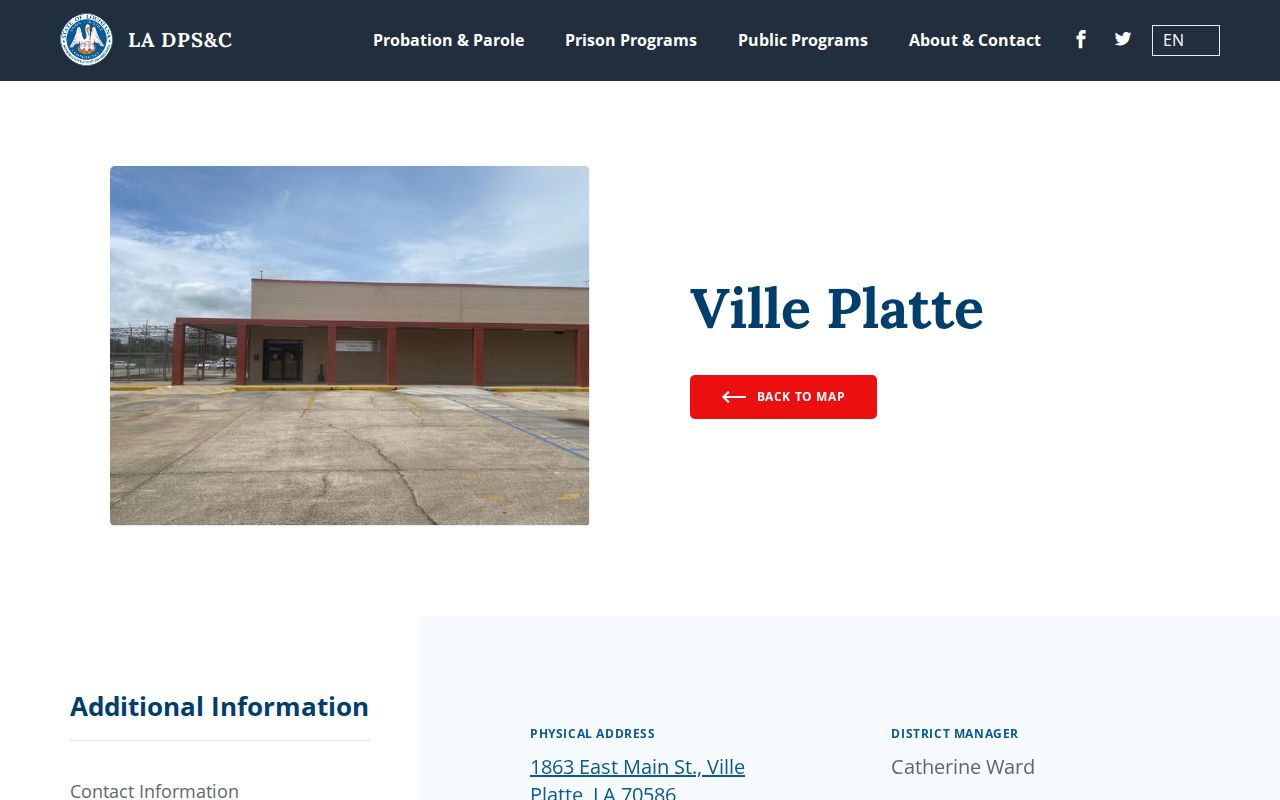
The captured state page identifies the office that serves Evangeline Parish, while an individual LAVNS result is still needed to connect a person to that district.
Evangeline Violations and Absconder Checks
No official public Evangeline Parish list of named absconders or supervision warrants was found in the research sweep. That gap should not be filled with an old jail card or an unofficial list. An absconder is a person alleged to have stopped reporting or left supervision without permission. A warrant or detainer may follow, but each status comes from its own official record.
Start by checking current custody in the agency that may hold the person. Then confirm the supervising authority. For parole, review the Committee on Parole information and its posted dockets or results when a hearing or revocation is involved. For probation, use the court order and supervising office. A prior release remains a past event even if the person later returns to custody.
Conditions vary by order and case. They may address reporting, travel, treatment, payments, or other conduct, but the signed terms control. A public search cannot safely reconstruct those terms. If a violation proceeding is pending, distinguish an allegation from a decision. A docket means a matter was set. A Committee result or court order states what the authority decided.
The Committee's published hearing material helps trace a parole matter, but each document has a narrow role. A hearing notice or docket shows that a case was scheduled. A result may say granted or denied and can include the authority's reasons. Neither one proves the exact time a person left custody. A grant can still be followed by release processing, stated conditions, a detainer, or another lawful hold. When a violation or revocation follows, compare the new result with the current LAVNS and custody records instead of carrying the first grant forward as if nothing changed.
Louisiana parole eligibility also depends on the offense date, conviction category, sentence, and statutory exceptions. The older percentage framework should not be used as a shortcut for an individual. For offenses on or after the 2024 law change, ordinary discretionary parole was eliminated while narrow exceptions remain. The Committee and DPS&C calculation control the individual record.
Evangeline Supervision and Final Discharge
Leaving a jail or prison does not always mean the sentence is fully discharged. Parole may continue for a stated remainder. Probation may begin after custody or run under a split sentence. Louisiana diminution-of-sentence rules can place a person on a statutory form of parole, and newer cases may involve unsupervised parole. “Unsupervised” still does not mean that the legal sentence vanished.
For a final answer, seek the record that ends the term. That may be a court minute showing probation termination, a DPS&C discharge record, an expiration shown by the controlling agency, or another official order. The Evangeline Parish Clerk of Court can provide the durable court record for a district-court probation matter. LAVNS may show the current community status, but its daily update and agency coverage make direct confirmation important when timing is disputed.
A registry entry answers yet another question. The Louisiana State Police registry can show a continuing statutory duty for a qualifying person, but registry presence does not prove parole, probation, or a release date. Keep release, supervision, court disposition, and registration as separate records.